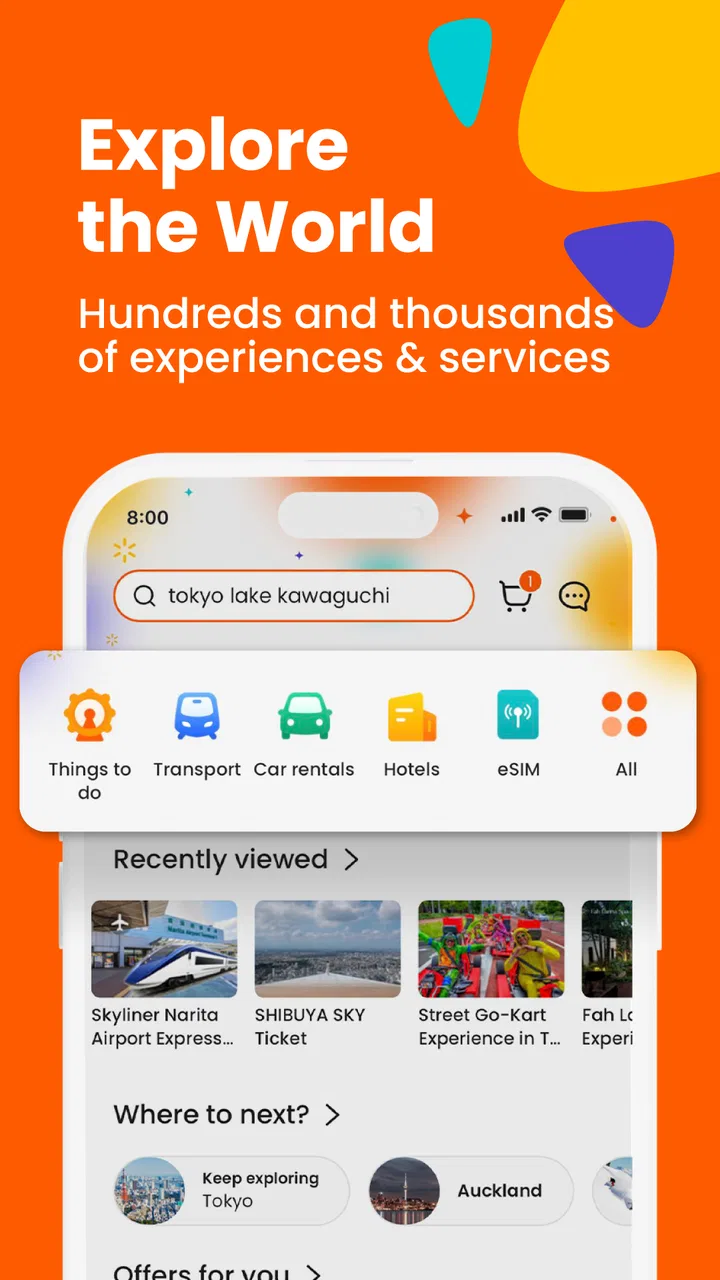
Klook: Travel & Activities
- 4.5
- Rating
- 10.00M
- Installs
- Free
- Price

 Analysis by App-foxy
I use Klook when I want to arrange the practical parts of a trip without jumping between several booking sites. It is a travel and local activities app from Klook Travel Technology Ltd. that brings tours, attractions, tickets, trains, and car rentals into one place. That sounds broad, but the real value depends on how you travel: it is most useful when you already know the destination and want to compare bookable experiences quickly, rather than when you are still trying to decide where to go.
The app is free, available to everyone, and its current Android release is version 7.39.0. It has been around since May 26, 2015, so it is not a new experiment trying to prove that mobile travel booking works. With more than ten million installs and a 4.3 average from roughly 136 thousand ratings, it has clearly become a familiar option for people planning holidays and short city breaks. I found its strongest quality to be convenience, although that convenience does not remove the need to read booking conditions carefully.
How Klook feels in everyday travel planning
I find Klook most useful when a trip is shared across a household or group, because browsing options together can turn scattered suggestions into a plan everyone understands. I’d use it to compare a few realistic activities before anyone commits, then check how those choices fit the day’s travel. That shared conversation matters as much as the booking itself, especially when different people have different schedules or needs.
You May Also Like

 Blood Strike: 2.5 Anniversary
Blood Strike’s Loadouts Turn Every Drop Into a Tactical Gamble
A close look at Blood Strike’s custom loadouts: how fast access to signature weapons reshapes its battle royale rhythm, rewards preparation, and narrows the gap between fights.

 Pandora - Music & Podcasts
Pandora’s Music Is Easy to Start, but Harder to Recover
Pandora’s strength is its low-effort path from a seed to a station. Its weak spot is how much confidence it asks you to place in connection, setup, and quiet recovery.

 8 Ball Pool
 Is Built on Rivalries, Rematches, and Routine
A close look at the rivalries, rematches, shared routines, and unanswered safety questions that turn a quick pool match into a persistent mobile community.

 Samsung Music
’s Quiet Strength Is Playing What You Already Own
Its reach comes less from spectacle than from dependable access to a personal library. That simplicity is both the app’s strongest retention engine and its ceiling.

 AccuWeather: Weather Radar
AccuWeather Review: A Quick, Clear Forecast for Everyday Decisions
For everyday plans, the best forecast is the one you can understand quickly. AccuWeather makes rain timing, radar, and local conditions easy to act on, with a few trade-offs.

 Hill Climb Racing
Why Hill Climb Racing Still Turns Crashes Into One More Run
A tiny car, a bumpy hill and one more upgrade: Hill Climb Racing keeps resurfacing because its simple chaos makes every near-miss feel personal.
More From Our News Desk
View All News


A useful starting point when the destination is already chosen
The first thing I noticed is that Klook works better as a destination activity finder than as a complete travel planner. I would not open it expecting to build an entire trip from flights to restaurant reservations. Instead, I use it after deciding where I am going, then search for the things that usually take time to arrange: entry to a popular attraction, a local tour, a train journey, a rental car, or a ticket for an activity.
That distinction matters. If I am comparing flights and hotels, a flight-search service or hotel-focused app is usually the more direct choice. Klook becomes more useful once I am thinking, “What should I book before I arrive?” It puts several types of local arrangements beside one another, which can save me from opening separate websites for every museum, transport operator, and excursion.
The interface is aimed at quick discovery. I can browse by destination and category, then narrow my attention to the type of experience that fits the day. This is particularly handy for a short visit where I have only a few free hours and want something that can be reserved in advance. It also helps when I am travelling with other people and need to turn vague suggestions into actual options that can be discussed and booked.
Where the app earns its place
For me, the most valuable workflow is to use Klook during the middle stage of planning. I first make a rough itinerary elsewhere, then use the app to check which activities need advance booking and which can be left flexible. That prevents a common mistake: filling every day with reservations before I understand the travel time between places.
A realistic example would be a long weekend in a city I have never visited. On the first evening, I might search for a central attraction and compare available tickets. For the next day, I could look at a guided activity or transport option, then leave the final afternoon open. Klook is useful here because the searches are connected to a destination rather than scattered across unrelated booking pages. I still check the attraction’s location and opening details independently, but the app gives me a practical shortlist.
Another less obvious use is separating “must happen” bookings from “nice if available” ideas. I treat timed entry, transport, and activities with limited schedules as the first group. Flexible tours and general sightseeing ideas stay in a second group. This approach makes the app less overwhelming and reduces the temptation to book simply because an option looks attractive in a list.
What the current version means for established users
Version 7.39.0 shows that the app is still being maintained as an active travel product rather than left in a finished but aging state. I see that as reassuring for people who depend on a booking app while moving between countries, because travel tools need ongoing attention as destinations, schedules, and booking flows change. A version number alone does not tell me that every screen is perfect, but it does support the impression that Klook continues to evolve.
For someone who has used earlier releases, the important effect is likely continuity rather than a completely different product. The central idea remains familiar: search for local travel products, inspect the details, and arrange them from a phone. Existing users should not need to rethink their entire planning method. The practical improvement comes from keeping the app current and using it as a single workspace for several kinds of reservations.
I would still avoid assuming that an updated app automatically means every supplier experience is equally polished. Klook presents the booking journey, but the actual activity may be operated by a local company with its own meeting point, schedule, and rules. My advice is to treat the app as a convenient front door, not as a replacement for reading the final voucher and activity instructions.
Reading a listing before paying
The most important habit is to inspect the details beyond the attractive title and photographs. I look for the date, time, location, duration, what is included, and what I need to arrange myself. A low-effort glance can create a high-effort problem later, especially if an activity begins outside the city centre or requires a specific meeting point.
I also pay attention to whether the reservation is suitable for my exact group. A family, a solo traveller, and someone with limited mobility may need very different information. The app is useful for discovering the options, but I do not let a clear-looking booking button make the decision for me. I want to know whether the timetable fits my transport plan and whether the ticket type matches the people travelling with me.
One of my preferred tactics is to save the booking information in a way that remains accessible when I am tired, offline, or dealing with weak reception. I keep the important confirmation details easy to find and note the meeting point in my itinerary. That is not a flashy feature, but it is the difference between a smooth morning and searching through an app while standing in an unfamiliar station.
How it compares with the usual alternatives
Compared with booking directly from an attraction or transport operator, Klook is more convenient when I am comparing several activities in one destination. The direct provider may be better when I already know exactly what I want, especially if I need the most authoritative schedule or a very specific ticket condition. Klook is strongest before that point, when I am exploring and assembling a plan.
Compared with a general search engine, Klook gives the search a more travel-focused shape. I am not merely collecting webpages; I am looking at bookable experiences and transport-related options in one travel context. The trade-off is that I must still verify the fine print and the local logistics. A broad search may reveal more background information, while Klook can get me closer to a reservation faster.
Compared with a dedicated itinerary planner, Klook is more action-oriented and less focused on mapping every hour of a trip. I would use an itinerary app to organise places, notes, and walking routes, then use Klook when I need to secure an activity or ticket. The two approaches complement each other, but Klook should not be mistaken for a full personal travel diary.
Where the experience can become frustrating
The range of categories is helpful, but it can also make the app feel busy. Tours, attractions, tickets, trains, and car rentals serve different planning needs, and a user who is only looking for one simple ticket may have to work through more choice than expected. I prefer it when I arrive with a clear destination and a rough idea of the activity, because unfocused browsing can quickly turn into decision fatigue.
There is also a trust issue that applies to any marketplace-style travel service: the booking screen may be easy to understand while the real-world experience depends on the local operator. I therefore judge a listing by its practical instructions, not just by its presentation. If the meeting point is vague or the schedule does not fit my day, I move on even if the activity itself looks appealing.
Another limitation is that convenience can encourage overbooking. Having multiple attractions and tours in one app makes it easy to fill a trip too tightly. I deliberately leave space for delays, meals, weather, and ordinary wandering. Klook helps me reserve plans; it cannot decide how much unplanned time I need.
Who should use it and who should skip it
I would recommend Klook to travellers who like arranging key experiences before departure, especially people visiting a destination for the first time. It is also a good fit for families and groups who want to compare several activities from one phone, and for travellers who prefer having tickets and reservations organised digitally instead of searching for them at the destination.
It is less suitable for someone who travels almost entirely spontaneously and dislikes committing to dates or times. It may also be unnecessary if I already know the exact local provider I want and prefer dealing with that provider directly. In that situation, the extra comparison layer may not add enough value.
Car-rental shoppers should be particularly careful about treating the app as a comparison shortcut rather than a final decision. The same practical questions still matter: collection location, driving requirements, insurance terms, fuel arrangements, and timing. I would use Klook to investigate available options, then read the booking conditions with the same care I would apply on a rental company’s own site.
Questions I would answer before relying on it
Is it suitable for a first-time visitor? Yes, if the visitor uses it to create a manageable shortlist rather than trying to book an entire holiday in one sitting. The destination-based approach is helpful when I do not yet know which local experiences are easy to arrange. I would combine it with a map and the official information for any attraction where timing or entry rules are especially important.
Can it replace direct booking? Sometimes, but not always. For comparing activities, tickets, trains, and rentals, it can be a convenient first choice. For a highly specific reservation or a change-sensitive journey, I may prefer the direct provider because its instructions and conditions are closer to the source. My decision depends on whether comparison or maximum directness matters more.
Is it useful for last-minute plans? It can be, provided I check the actual availability and timing shown for the activity. I would not assume that every listed option is suitable for immediate use. A last-minute booking still needs a realistic route to the meeting point and enough time to receive, open, or present the required confirmation.
Does it work for different travel styles? It suits both independent travellers and groups, but in different ways. I use it independently to research and reserve; in a group, I use it to make the options visible so everyone can agree on the plan. Travellers who want a completely unstructured trip may find the reservation focus less appealing.
What I would like to see continue improving
The current release gives me confidence that Klook remains an active app, but the next useful improvements would be the ones that reduce uncertainty rather than simply add more choices. Clearer distinctions between flexible and tightly timed bookings would help me plan more realistically. Better emphasis on meeting points, travel time, and important restrictions would also make the app safer to use during a busy trip.
I would also value a smoother boundary between discovery and verification. The app is good at helping me find possibilities, while the final decision still requires careful reading. Anything that makes the essential conditions easier to notice without hiding them behind extra taps would improve the experience for both new and experienced users.
For existing users, the main thing to watch is how future releases handle the balance between a wide catalogue and a calm interface. More options are not automatically better if they make it harder to identify the right ticket for a particular day. I would rather see the app become more precise about suitability than simply more crowded with listings.
My final recommendation
After using it as a planning companion, I see Klook as a practical middle ground between searching the open web and booking every item directly from separate providers. Its free access, broad travel focus, and established presence make it easy to justify installing before a trip. The app is especially helpful when I need to compare local experiences and turn a rough destination idea into a few concrete reservations.
My recommendation comes with one firm condition: slow down at the final booking stage. Check the date, location, timing, inclusions, and instructions, then make sure the reservation fits the rest of the day. Used that way, Klook: Travel & Activities can remove a lot of small planning friction without taking control away from me.
I would choose it for organised city breaks, attraction planning, transport-related bookings, and group discussions about what to do next. I would skip it when I already have a trusted direct provider or when spontaneity is the whole point of the journey. Overall, the app earns a place in my travel toolkit because it helps me move from “that looks interesting” to “this fits my actual itinerary,” while still leaving the final judgement in my hands.
FAQs for Klook: Travel & Activities
01What is Klook and what can I use it for?
Klook is an online platform and mobile app that allows users to discover and book travel activities, attractions, and services worldwide. It offers a wide range of experiences, such as tours, theme park tickets, and local transportation. Klook is ideal for travelers looking to enhance their trips with unique and convenient activities.
02Is Klook available worldwide and in multiple languages?
Yes, Klook is available in multiple countries and supports various languages, making it accessible for global users. The platform covers popular destinations across Asia, Europe, America, and more. Its multilingual support ensures a seamless experience for users, providing detailed information about each activity and service in their preferred language.
03Are the bookings on Klook reliable and secure?
Klook prioritizes user security and reliability by partnering with reputable local operators and service providers. The platform offers a secure booking process with encryption to protect user data. Additionally, customer reviews and ratings help ensure transparency and trustworthiness, allowing users to make informed decisions before confirming their bookings.
04How do I receive my tickets after booking on Klook?
After booking an activity or service on Klook, users receive an e-ticket via email, which can also be accessed through the app. These e-tickets usually include a QR code or a confirmation number needed to redeem the service. It's essential to check the specific instructions for each booking, as some may require physical tickets to be picked up at designated locations.
05What is Klook’s cancellation and refund policy?
Klook's cancellation and refund policies vary depending on the activity and service provider. Some bookings offer free cancellations up to a certain period before the activity date, while others may be non-refundable. It's crucial to review the cancellation terms on the activity page before booking, as they provide detailed information about potential refunds and changes.
Pros
- Wide variety of activities available
- Easy booking and cancellation process
- User-friendly interface
- Competitive pricing and discounts
- Excellent customer service
Cons
- Limited offline functionality
- Occasional app crashes
- Some activities lack detailed reviews
- Inconsistent refund timelines
- Limited language options for some content

Klook: Travel & Activities
Gallery